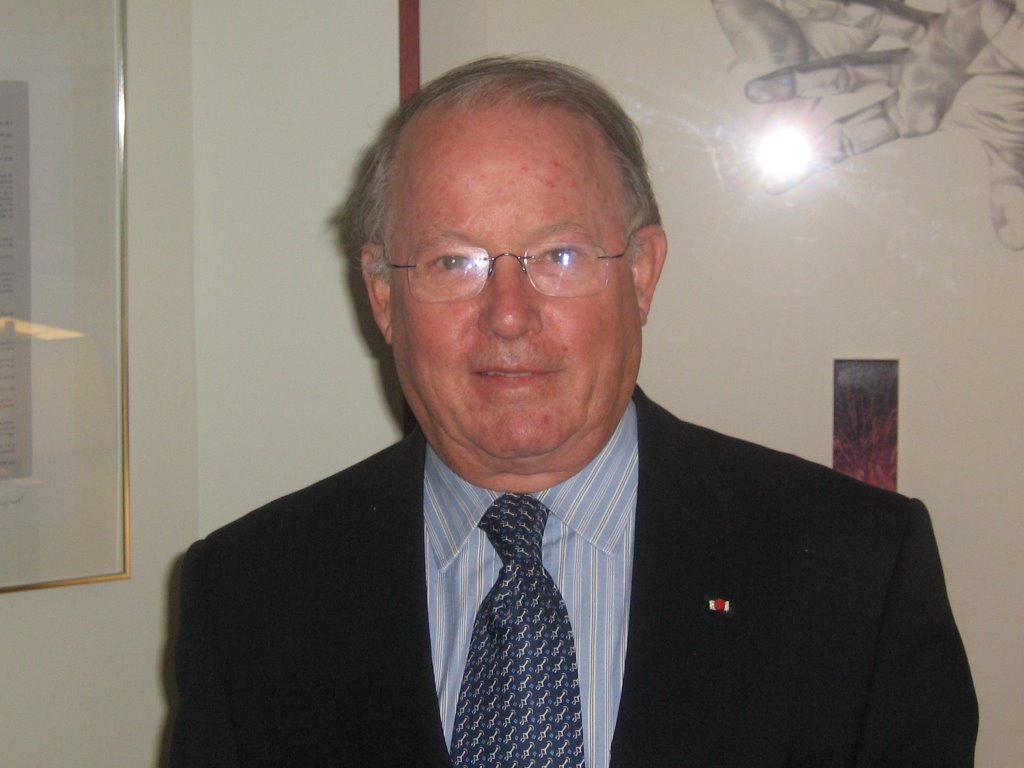
Saturday, November 11, 2006

Bernard Landry Interview (Part 3)

Back to the action. For those just joining the party in progress, I highly recommend checking out the first couple of parts of the interview. The beginning of this little adventure can be found here.

Whenever I talk to a lifelong sovereignist, I can’t help but ask if there’s anything that can be done to reconcile the two solitudes, aside from splitting Canada up into its component parts. The answers are usually pretty similar. At this point, I’ve typically heard that they just feel it’s time to try things on their own.

“Frankly, there is not so much animosity and thank God! We’re in good relations with the rest of Canada, but nothing can be done to prevent us [from seeking] liberty for our nation. A nation must be free. There is literally no real compromise except independence.” Landry said.

So it appears we’re at an impasse. The Parti Québécois has been around for 36 years now and don’t appear to be going anywhere anytime soon.

“What Canada should do, formally, that could be in the interests of Canada and in the interests of Quebec, is accept that Quebec is a nation—accept that formally, which is not the case.” Landry suggested. “That’s the base of everything for the future; the way England recognizes Scotland as a nation; the way Spain recognizes Catalonia as a nation. Why doesn’t Canada do the same?”

Alright, let’s suppose that Quebec chooses to leave Canada. What happens to the small francophone communities in the rest of the country? The Quebecois would be essentially turning their back on their linguistic brethren, wouldn’t they? Not necessarily, according to Landry.

“They will be more protected if they could count on a new French-speaking country, member of the United Nations, UNESCO and other international organizations, to help them live as a minority and to give the example to treat the minority in the way we treat English speaking Quebeckers,” he explained. “As an independent country, we could be in a very good position to be an example to the rest of Canada, and to many other countries in the world, how to treat minorities.”

This is where he and I sharply disagree. Are English-speaking minorities respected in Quebec? For the most part, yes, though I can attest to how difficult it is for an Anglophone to try and find work in this province without being perfectly bilingual. I would argue that any “respectful” treatment Anglophones receive has more to do with the fact that they were historically part of the ruling class and thus, had the money and influence to ensure their needs were taken care of. In my opinion, it has nothing to do with Quebec’s respect for minority groups. Money talks. So he and I will have to agree to disagree on this point.

Longtime readers will remember that I typically end off my interviews by asking my guest to give me some adjectives to describe Quebec. Here’s what Monsieur Landry came up with:
“Culture is important. Solidarity is important. And to be open to the rest of the world is important. That’s the 3 most interesting characteristics of Quebec. Look at the cooperatives we have here, the unions we have, the social system we have,” he said. “And young Quebeckers travel all over the world. The population in Quebec travels more that the rest of Canada, outside of North America. You should see the proportion of Canadian passports held by the Quebec population compared to Ontarians or the West. Look at our culture: Celine Dion, Cirque du Soleil, Denys Arcand, many singers, dancers and musicians. Quebec is sort of a synthesis between North America and Europe. It’s the most European part of North America, no doubt.”

So looking back on his career in politics, what is Monsieur Landry most proud of? The economic revolution and transformation of Quebec that he, along with many others, were a part of.

“When I was young, we were exporters of aluminum, pulp and paper, wood and that sort of natural resources. Today, we export airplanes, telecommunication materials, pharmacology products, high technology with our sophisticated engineering firms, multimedia and so on. We started from raw materials and mining and forests and we went on to technology,” Landry said.
I would like to take a moment to thank Monsieur Landry for granting this interview and giving me the opportunity to learn a bit more about the sovereignty movement in Quebec. Hopefully my readers enjoyed it as well. Til next time…

Labels: , , ,

Friday, November 03, 2006

Bernard Landry Interview (Part 2)

The introduction to this interview can be found here.

I was born in November of 1974 so my parents were hip-deep in my “terrible twos” when the Parti Québécois (PQ) won the provincial election in November of 1976. Obviously I don’t remember a thing about that time period, but from what I’ve read, the PQ’s victory was nothing short of shocking in English Canada. Despite warnings in Laurendeau-Dunton report of 1969 of unrest within the francophone population, no one really believed that a sovereignist party would form a government. And according to Landry, it surprised even the PQ itself!

“It was not in our mind, at all.” Landry said. “It was the start of a movement. It was clear that the movement was not designed for [impatient] and ambitious people. Even in Lévesque’s mind, it was to be a long road. He was mistaken at that point because 6 years [after the PQ formed] we were in power. And we’ve governed Quebec most of the time since that period.”

Lévesque was in it for the long haul and gathered together people who were prepared for a struggle that may not be fully realized for decades. It definitely wasn’t a task for the faint of heart. Monsieur Landry recounted Lévesque’s theory to me:

“Lévesque said to me, in 1970, ‘It will be a long road, but independence should come when a generation will have passed.’ A generation is about 25 years, so Lévesque was [almost] right because, in 1995, we got 50% of the vote for independence.” Landry said.

I asked the former Premier of Quebec to think back to 1976 and to tell me about his first reactions to learning that, not only had he won his seat in the National Assembly, but also that his party would lead the government. In a word, he was stunned.

“It was incredible. It was so strange. Not for a fraction of a second did I think that I could beat a cabinet minister.” he said. But once he secured his seat, he just wanted to be a “member of the National Assembly and doing my best to have our ideas progress. Those ideas being progression [of Quebec] and sovereignty.”

Now I had heard different terms over the years, ranging from the total independence of Quebec to some sort of Sovereignty-Association, so I wanted some clarification. What is it he was fighting for? I wanted to clear up whatever misconceptions I may have had about the movement and look at things with an open mind, if I could.

“For Lévesque and people like myself, we were rather constant. For Lévesque, Quebec’s adventure was a national adventure and not an ethnic adventure. Lévesque was an inclusive man and, by the way, in ’76 we elected the first black people in the National Assembly. Many members of the cultural communities were in the first staff of the party.” Landry explained. “We were inclusive at that time and we’re still inclusive.”

“Second, Lévesque was in favour of a close economic association with the rest of Canada. It’s still my point of view: an independent Quebec, but with a free circulation of goods, services and persons between Quebec and Canada, just like they have in the European Union.” he said.

Now obviously there’s a big difference between the half-billion person economy and the 30 or so million that make up Quebec and Canada, but Landry is confident that a very equitable, free trade agreement could be made between the two groups. But why is there a need for an independent Quebec? Why leave Canada?

“There are many, many reasons. The first one is dignity. Quebec is a nation. That’s absolutely clear. Almost no one today objects to that because it’s a fact. Jean Charest is in agreement and [Michael] Ignatieff is in agreement—even Stéphane Dion. So if you are part of a nation, why would you be satisfied with the status of Prince Edward Island? A nation cannot be a simple province of another nation. It’s a matter of identity and dignity.” he explained.

“Starting from that principle, many material reasons are connected.” he continued. “The Canadian nation is managing its own interests. Sometimes it coincides with Quebec’s interests, sometimes not… but Canada is working for Canada and the Canadian nation and it’s detrimental in many, many ways to the interests of Quebec. There are many examples in history [where] the Canadian interests are one thing… [but] it’s directly against Quebec’s interest. An historical example: Wilfrid Laurier, Prime Minister of Canada, was advocating free trade between Canada and the United States in 1911. He was defeated and we had no free trade until recently with Brian Mulroney. It was in Quebec’s interest to have free trade. It’s obvious. We’re near New York. We’re near Boston. We connect directly, North-South. No. We were confined to Canadian economic space. It was against our interests, but it was probably good for Toronto and Canada as a whole. But not good for Quebec.” Landry said.

“My sovereignist convictions are not based on resentment. It’s based on our interests in the future and even with Canadian interests.” he clarified. “It’s not in the interests of Canada to be constantly fighting Quebec’s aspirations and trying to centralize when Quebec wants to de-centralize. Some things must be centralized in Canada, in the interests of New Brunswick and Prince Edward Island, but it’s against Quebec’s interests. So if Quebec is out of Canada, Canada will be in a better position to live its destiny and organize itself along values that are good for Canada. At the moment, it’s an internal fight: on constitution, on budget, about everything! It’s not good for Canada and not good for Quebec.”

It’s time to hit the pause button again and pick this up again another day. Next time we’ll wrap up my afternoon with Bernard Landry. Til next time…

Continue on to Part 3.

Labels: , , ,

Sunday, October 29, 2006

Bernard Landry Interview (Part 1)

The introduction can be found here.

Alright, let’s get back on track now. I had left off in the waiting room of Bernard Landry. He had a meeting prior to mine, so I had plenty of time to calm my nerves. When it was finally my turn, I was directed into a small meeting room with a central wooden table. I noticed that the walls were decorated with a series of inspirational poems (in French, of course). There were also some books in one corner that covered topics in economics, as well as one by René Lévesque. Fitting, considering how much of an influence the founder of the Parti Québécois had on Landry, dating back to the beginning of his career.

When Monsieur Landry joined me, he carried a copy of the e-mail I had sent to his assistant, highlighted to remind him of who I was and why I was there. I can only imagine that someone of his public stature must get requests on a daily basis and it would be next to impossible to keep track of them all. He addressed me in French, asking me in which language I preferred to conduct the interview. I explained that, though I was quite sure I could conduct it in French, that the eventual transcription would make it very difficult for me to accurately reproduce his answers. And since I strive for accuracy above all else in my citations, I would be more comfortable in English.

Interestingly, he asked me some questions of his own (still in French), such as where I was from, where I learned French, etc. It was a nice gesture as it helped to break the ice a bit and make me more comfortable. I would have liked to spend more time casually chatting, but I was there to conduct an interview. Best to be professional about it, right?

I wanted to get a better sense of the man and his motivations, so I started with questions about his family and his education. As it turns out, Landry was raised in an atypical family for the Quebec of that time. While most families in his village had a dozen children or more, he was an only child. But it wasn’t long before his parents decided to adopt two little girls. That being said, while a family of 3 children might be considered large today, it was pretty small, especially when you consider that one of his neighbours had a family of 22!

He pursued studies in both law and economics at the university level, but I was curious about how he ended up in politics.

“These studies, law and economics, are highly compatible with politics, of course.” he explained. “My intention was to be a public servant. I went to Quebec City to work as an employee for René Lévesque, who was a Liberal minister at that time, with the Department of Natural Resources. And it’s Lévesque that advised me to study economics because that was a priority of the Liberals of that time and the Quebec of that time.”

Quebec was in the midst of what’s been called the Quiet Revolution (or la Revolution Tranquile en français), which was a modernizing of Quebec from a mainly rural province to a more industrial and production-focused economy. As such, there would be a need for economists. Landry’s studies in Europe affected his outlook on Quebec’s relationship with Canada, so when Lévesque contacted him about running for the Parti Québécois, it seemed like a natural fit.

“When Lévesque founded the Parti Québécois, he called me and said, ‘I would like you to be one of our candidates.’ In my reflections, I was already going directly toward Quebec sovereignty and independence because I studied economics in Europe and I had seen how modern countries can be independent and, at the same time, share the same economic space.” he said. That was also why he participated in the Free Trade debates and supported the NAFTA treaties.

Prior to the formation of the Parti Québécois, Landry was a Quebec Nationalist with strong leanings toward being a sovereignist. This is where it starts to get a bit complicated for those who don’t live in Quebec. It’s not as simple as “Conservative,” “Liberal” and “Socialist” here. Those seem to be almost like flavours of other designations like Nationalists, Federalists and Sovereignists. I asked him to try and clear things up for me a bit and here’s what he told me:

“You have some Quebec Nationalists still today, members of the Liberal Party of Quebec or Canada, wanting to cultivate Quebec’s differences, protect the language and so on, and saying that they prefer to do that within Canada. To me, it’s a paradox, but not according to them.” he said. “To me, if you’re a nationalist, you favour the independence of your nation. But as a consequence of the past, some old nationalists are still not sovereignists. Some Federalists are Quebec Nationalists in the old sense of the term. It’s complicated, but even la Société St-Jean Baptiste in Quebec City and, I think in a northern city, I think it’s Sherbrooke, are traditional Quebec Nationalists, fighting for language and culture and so on and are Federalists at the same time, but they are more and more marginal.”

Okay, so if I understood that correctly, Nationalists, both of the Federalist and Sovereignist varieties, are fighting for the preservation of the French language and culture, but disagree on the best way to accomplish it. One can consider oneself a Federalist without being a Quebec Nationalist, but it’s not really possible to be a Sovereignist without being a Nationalist. This looks like a good place to stop for now, but we’ll pick this up with thoughts on the 1976 election. Til next time…

Continue on to Part 2.

Labels: , , ,

Tuesday, October 03, 2006

An Afternoon with Bernard Landry

Today I’m going to turn back the clock about 3 weeks. While the eyes of Quebec, and to a certain extent, Canada, were focused on Dawson College and the sheer insanity that took place that day, I was walking from my office near Mont-Royal down to Old Montreal. I had heard what was going on, of course, which was the reason I was walking. The metro lines were stopped along the route I needed and although I had given some thought to trying to reschedule, I felt it was better to go ahead with the interview. After all, Monsieur Bernard Landry was a busy man. If it was going to be a major problem, then his assistant would call and cancel. So far, no call. So off I went, through the light mist and rain.

I had over-estimated how long it would take me to get there, so I had a bit of time to look around. I noticed that his name was absent from the lobby directory listing of businesses and offices that occupied the building. I suppose it’s best to keep a low profile when one is the former leader of the Provincial government’s opposition party. It ensures a certain amount of privacy can be maintained, especially now since he’s no longer officially a public servant. I checked the address for the umpteenth time and headed to the designated floor.

Obviously I didn’t get a guided tour of the office, but it wasn’t quite what I expected. The door was unmarked, except for the office number, so I was a bit unsure of whether I was in the right place. Fortunately, the portrait on the wall gave it away. I checked in with his secretary and then took a seat. There was a TV in the waiting room, tuned to the latest happenings over at Dawson. I had pretty much tuned out at this point, trying to keep my mind on the matter at hand. In a few minutes, I would be meeting with Monsieur Landry.

Next time, the interview. Til next time…

Continue on to Part 1.

Labels: ,